.svg "Back to home")


Where Data Center Security Quietly Breaks Down
Door entrances are typically treated as a control, not a risk, in most data centers.
Once “configured” access is checked off the list, it’s rarely looked at again unless something stops working. Everything seems in order, and that’s precisely where the problem starts.
Redundancies for power and cooling get checked, tested, and stress-modeled regularly. Network designs are reconsidered as threats shift and change. Entrances are the opposite. Once they’re up and running, they recede into the background. Or worse, they keep humming along exactly as they’re configured, but the ways we use them start to shift without us noticing.
Entrances as Invisible Infrastructure
Entrances are control points. They straddle IT, facilities, security, compliance, vendors, contractors, auditors, and operations. But once they’re in place, we tend to treat them like a utility you never have to think about again.
Except that entrances don’t magically work by themselves. They work through people. And people optimize for throughput.
Slowly, workarounds creep in. Doors get held open. Contractor badges get recycled. Temporary access gets reused instead of revoked. Shared entrances go unchallenged.
Tailgating That Feels Efficient
Tailgating rarely looks nefarious in the data center. It often looks productive.
Morning rush-hour commutes, vendor deliveries, shift changes, and system audits all create moments when individuals are moving quickly, often with equipment in tow. Person A badges in, and person B ducks through right behind.
The unfortunate truth is that data center teams have probably tolerated deliberate tailgating when they were busy in order to keep things moving. Enforcement becomes inconsistent. The badge reader scanned someone, so nothing seems wrong. The choice to let the second person in wasn’t made by any system but instead by an individual’s discretion.
That’s the quiet bypass.
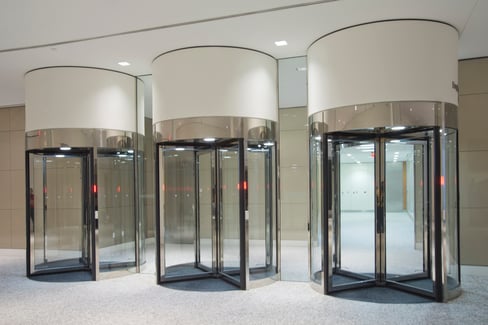
Security revolving doors such as the Tourlock 180 are designed to remove that discretion by enforcing one-person-at-a-time entry without relying on social confrontation. Yet in many facilities, primary entrances still depend on individuals choosing to challenge minor behavior in the moment.
When Contractor Flow Redefines Control
Entrance integrity tends to drift when it comes to contractor management.
Vendors rotate frequently, technicians change, projects overlap, and temporary access is issued quickly to avoid delays. A badge may even get shared “just for today.” Over time, access control shifts subtly from identity-based to familiarity-based.
The drift worsens with shared entrances. When employees, contractors, deliveries, auditors, etc., all enter through the same door, enforcement naturally becomes flexible. During peak times, guards prioritize flow, and teams assume screening has already occurred.
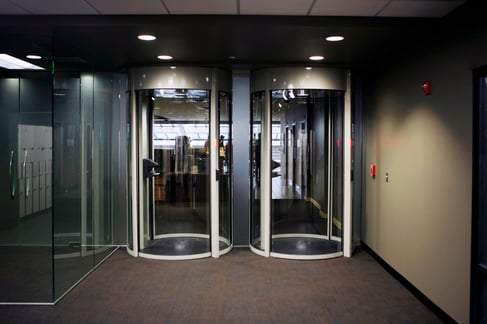
High-deterrent turnstiles like the Turnlock 100 can help prevent unrestricted flow at the perimeter, but humans still override those systems when it’s convenient—by switching to free mode during deliveries, temporarily disabling controls, or relaxing enforcement to keep traffic moving. Once you pull that thread, the culture of your entire facility shifts.
The Comfort of “Badge = Secure”
If someone has a badge, we assume they’ve been vetted. If the reader flashes green, we assume authorization is sufficient.
But a badge doesn’t prevent tailgating, identity substitution, or credential sharing. The presence of a credential is misunderstood as validation of good security behavior.
Entrance systems designed to enforce one credential per person make piggybacking difficult without requiring staff to confront someone directly. Traditional badge readers rely heavily on policy and human intervention. If someone swipes into a system, it only logs that a credential was presented—not exactly who walked through the door.
Temporary Exceptions That Quietly Solidify
What if there’s an emergency override left enabled a little longer than intended? Offline mode gets turned on during integration efforts. Maybe someone propped open a secondary entrance due to renovations.
Workarounds become operational. It’s not the exception that creates risk, it’s normalizing it. That side entrance ends up remaining in a less restrictive posture “until we have time to fix it,” which might be weeks or months. It just feels normal because nothing is catastrophically breaking.
Time passes, and an audit discovers discrepancies between written policy and implemented reality. Or a near miss exposes how many temporary fixes were wrapped around that one solution. By then, the transition will have already been normalized.
Legacy Designs in a Modern Threat Environment
Many entrance systems reflect the threat model of the year they were installed.
Five or ten years ago, contractor volume may have been lower. Compliance scrutiny may have been lighter. Cyber-physical convergence may not have been a primary concern. The entrance design worked then — and technically still works now.
But does it align with today’s operational complexity and risk posture?
Cybersecurity frameworks take rigid physical controls for granted. Newer standards mandate you prove they're enforced, not just documented. They need to perform under heavy load, 24/7, and in plain sight or utter darkness, not just a random Tuesday when things are humming along.
If your door set depends on alert humans, the strength of that door set ebbs and flows with staffing levels, attentiveness, vacation days, and employee turnover. Data centers don’t take vacations or sleep, but people do.
When “Working” Isn’t the Same as Secure
Doors are cyber-physical choke points. Once someone has physical access to network gear, digital defenses become secondary.
Allowing tailgating, sharing contractor badges, leaving bypasses enabled, and relying on shared entrances…none of these actions seem earth-shattering by themselves. Together, they leave you vulnerable before breaching even becomes a factor.
Because entrances don’t appear on the same dashboards as servers or cooling systems, that exposure remains quiet.
A More Useful Question
This isn’t about rearguing that entrances are critical infrastructure. It’s about acknowledging that entrances quietly drift from their original design intent as operations scale.
The right question is not if your entry system works. It’s about whether your entry system still works based on how your facility operates.
Does it eliminate gate discretion when they are busiest? Does it best enable one person per badge always? Does it scale to the same execution at 2 a.m. that it does at 2 p.m.? Does it represent your current and future contractor volume and audit requirements?
Walk through your access process tomorrow. Begin at the perimeter fenceline and conclude at the server room during busy hours. When you do, does reality perfectly mirror the policy on paper? Or does it seem a tad too lax?
That slight disconnect between design and everyday practice is where data center security silently fails more times than not. Identifying the gap before it’s breached is what distinguishes preventative facilities from reactive ones.