.svg "Back to home")


Why Data Centers Outgrow Their Entrance Design
For years, the conversation around data center security has focused heavily on cyber threats. Firewalls, encryption, and multi-factor authentication have all become standard defenses in protecting sensitive systems. But while cyber defenses have evolved rapidly, physical security (especially at the entrance level) hasn’t always kept pace.
Risk management professionals have been raising concerns that physical security programs are increasingly overlooked, even as they remain the first layer of protection against malicious intent. And in many facilities, the issue isn’t that entrances have failed. It’s that they’ve quietly fallen out of alignment with how the data center actually operates today.
The Problem Isn’t Broken Doors...It’s Changed Conditions
The majority of today’s data centers weren’t built to handle the traffic they see now.
Contractor traffic volumes were much lower five to ten years ago. Regulatory compliance standards weren’t as robust. Most organizations hadn't identified the relationship between physical access and cybersecurity risk. For many data centers, a basic door access system that simply opened and closed doors was once considered sufficient.
Door access systems that worked flawlessly back then are likely still operating just fine today. However, they may not be operating adequately for today’s needs.
Facilities evolve. More vendors and contractors come onsite. Compliance expectations expand. Hybrid environments increase the number of access points, both physical and digital. Meanwhile, threat actors have become more sophisticated, often relying on subtle infiltration rather than force.
The entrance design, however, often stays the same. Over time, this creates a gap between what the system was built to handle and what it’s now expected to manage.
The Rise of “Workarounds” in Legacy Entrances
When access systems become stagnant, workarounds naturally develop around them.
These workarounds typically don’t occur overnight. They creep up slowly through little tweaks made to patch existing systems. A badge reader might be added to a door that was never designed for controlled throughput. A turnstile might be installed to improve visibility, even if it doesn’t fully prevent unauthorized access. Guards may take on a more active role, monitoring entry points or managing visitor flow manually.
Everything seems fine on the outside. Individuals are entering and exiting as they should. There are no glaring breakdowns.
Underneath that, organizations begin relying less on engineered systems and more on human intervention. This change may not be noticeable on a day-to-day basis, but it breeds inconsistency and ultimately risk.
Why “Detection” Isn’t the Same as “Prevention”
Many legacy entrance setups are built around detecting issues rather than preventing them.
A camera might flag tailgating after it happens. A guard might notice someone slipping through a door. An alert may trigger when something looks off. These measures are useful, but they are reactive by nature.
By the time detection occurs, the breach has already taken place.
In a data center environment, that distinction matters. Physical access can render many cybersecurity measures irrelevant. Someone inside the facility can connect to a network port, access an unattended device, or remove hardware altogether.
If unauthorized individuals can enter the building, the rest of the security stack becomes significantly less effective.
Where Legacy Design Starts to Show Strain
Older entrance designs start showing their limitations as facilities expand, not through failures, but through friction.
Throughput struggles to keep up with demand as more and more people need access. Speed vs. control tradeoffs become compromises. Visible security does not always equate to controlled access. Guards become more of a crutch than a backup.
Even layered security can lose its effectiveness if it wasn’t designed as a cohesive strategy. Instead of creating progressively stronger barriers as someone moves deeper into the facility, access control may feel inconsistent from one point to the next.
The Case for Rethinking Entrances. Not Just Upgrading Them
Installing another badge reader or camera will not solve the problem if your entryway was not designed to control access, deter tailgating or badge sharing, and scale with your business needs. Cameras may help you see better, but they won’t change how access is controlled.
That’s why many data centers reach a point where rethinking the entrance strategy becomes the logical next step. Not because something broke, but because the environment around it changed.

What Modern Entrance Design Looks Like
Modern data centers are increasingly adopting a layered approach to entrance security, where each access point plays a defined role in controlling movement through the facility.
At the perimeter, the focus is on keeping unauthorized users off the property entirely. Physical barriers like full-height turnstiles act as both a deterrent and a control point, limiting access before individuals even reach the building.
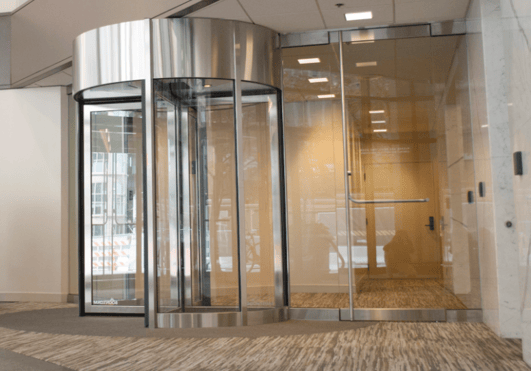
At the building entrance, the goal shifts to ensuring that only authorized individuals can enter, and that they do so one at a time. Solutions like security revolving doors help enforce this without relying heavily on staff intervention.
Inside the facility, additional layers help manage how people move through different zones. This ensures that visitors, contractors, and employees only access areas appropriate to their role.
At the most sensitive level, such as server rooms, stricter controls verify not just that one person is entering, but that it’s the right person. Technologies like interlocking mantrap portals and biometric authentication create a higher level of assurance where it matters most.
Together, these layers form a system designed not just to observe or react, but to actively control access at every stage.
Why This Shift Matters Now
Today’s intruders don’t always force their way in. They blend in. They may appear as contractors, vendors, or even employees using valid credentials. Instead of exploiting technical vulnerabilities, they exploit gaps in process and design.
And in many cases, those gaps exist not because of poor planning, but because the facility has evolved beyond what its original entrance system was designed to support.
From Functional to Fit-for-Purpose
A legacy entrance can still be fully operational and still be misaligned with current needs. The question is no longer whether an entrance works but whether it works for the way the facility operates today.
As data centers continue to scale and the lines between physical and cyber threats blur, entrances take on a more critical role. They are no longer just access points. Instead, they are essential components of a broader security strategy.