.svg "Back to home")


The Warehouse Entrance is a Business System.
If you’ve ever stood near a warehouse entrance right as a shift starts, you already know what happens. Foot traffic increases sharply. A line forms at the door. Someone sticks a chair under it to keep people moving. The guard waves people through to ease congestion. By the time everyone is on the floor, the workday has already started off compromised.
But none of this feels abnormal. Instead, it feels completely normal... and that’s the problem.
Ordinary moments like these reveal a truth many operations teams ignore: The warehouse entrance isn’t just a door. It’s an operating system for how people move through the building. If that system is not purposefully designed, it slowly erodes labor efficiency, safety, shrinkage, and resilience.
It’s not that most warehouses have a problem with their entrance. It’s that they have a problem with their entrance design.
Warehouses Have Evolved. Entrance Design Must Adapt.
Warehouses have long since moved beyond simple storage boxes into higher-value commerce hubs, playing a central role in global supply chains. Inventory turns faster, headcounts are larger, and throughput expectations are higher, making disruption more costly.
Most operations, though, still see entrances as just hardware rather than as part of their infrastructure.
Entrances behave more like conveyors, dock doors, workflows, and software systems — not customer-facing checkpoints, but operational infrastructure. Entrances control the flow of people. They create or resolve bottlenecks. They impact how smoothly people can shift from one activity to the next. When design doesn’t work, the results don’t usually present as “security issues.” You experience queues during rush hour. Guards hold people up to try to keep the flow under control. Screening is haphazard; some are queued, some skip through. Doors are left open because the system can’t cope. “Day-to-day fixes” become the new normal. These incremental inefficiencies add up. Five minutes lost at the beginning of every shift multiplies to hours of work lost per week.
Shift Changes Are the Benchmark for Entrance System Design
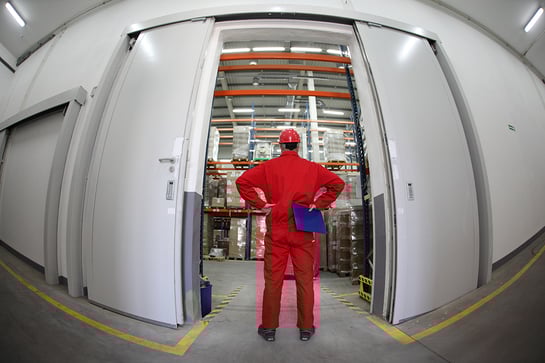
Shift changes are when entrance design problems become most visible. They are a predictable warehouse operation stress test. Hundreds of people arrive in a narrow time window. Delays at the entrance ripple across the floor in minutes.
Unpredictable lines form. People get frustrated and agitated. Safety risks rise. Supervisors can’t tell who is onsite, when, or where. Guards have to choose between speed and control. Informal workarounds replace official processes to keep things moving.
The entrance becomes a bottleneck not due to the security itself, but because the system wasn’t built to handle scale.
Security Should Be the Solution, Not the Starting Point
Security often only becomes a topic after a problem arises. Theft climbs. An incident occurs. Liability becomes a concern. Only then do teams start reexamining entrances.
By that point, the system has probably not worked well for years.
The best entry security strategies start with operational workflows instead of threats. When access control and screening logic follow the natural flow of people through the facility, security becomes a throughput enhancer, not a bottleneck. Accountability is predictable. Visibility is improved without additional staff. The operation runs faster because the system is working, not because the rules are ignored.
Entry, Breaks, and Exits Are One System
Performance at the entrance isn’t just about the start of the shift. People go on breaks. They take lunch. Visitors, contractors, and drivers come and go throughout the day. At the end of the shift, when patience is low and shrink risk is high, everyone is leaving at once.
These moments are all part of one workflow, whether they’re designed that way or not. When they are handled well, movement becomes predictable, measurable, and efficient. When they aren’t, congestion rears its head everywhere.
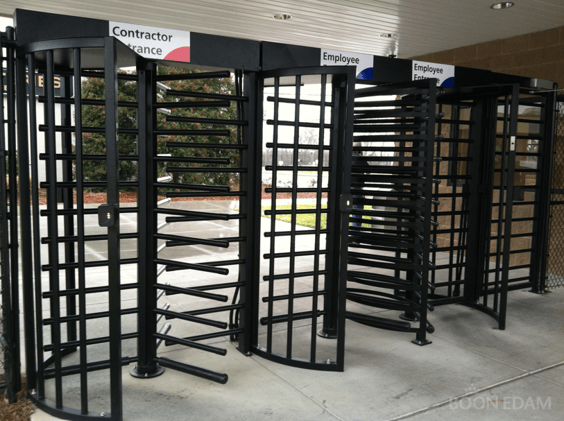
Layered access control is where this is most visible. Zones perform different functions, but each use case still follows the same underlying flow. The result is consistent movement without congestion.
Shrinkage Is Often the Result of a System Failure
Inventory shrinkage is almost always defined as a security problem, but for many warehouses, it is a design problem. Warehouses crammed with high-value goods are magnets for internal and external theft. Shrinkage hits bottom lines directly, but most effective solutions are neither punitive nor add a lot of extra work.
The most effective deterrence is a well-understood exit process that sets expectations, ensures fair accountability, and focuses controls on the highest-risk areas. Behavior changes when people know how movement is managed and that exits are part of a managed system.
It works the same way cybersecurity does. Controls are focused on high-risk areas. Activity is monitored. Data is used to improve the system over time. In physical space, entrances and exits serve the same purpose. They act as feedback loops, not just chokepoints.
Entrances Protect People Without Stopping Flow
Protecting people is another function of entrance design. The incidents are few and far between, but in the grand scheme of things, the consequences can be catastrophic. Well-designed transition points between public space, administrative offices, and warehouse floors can keep unwanted visitors from moving at full speed, without impeding day-to-day business.
Moments of pause from calculated access control are time buffers to respond, evacuate, and/or contain the situation at hand. We aren’t trying to build bunkers out of our warehouses. We are trying to design processes that keep people safe while maintaining workflow.
Treating Entrances Like Infrastructure Produces Tangible Business Benefits
When entrances are treated as infrastructure rather than hardware, the benefits show up across the business. Labor costs go down as standardization makes processes simpler. Peak time congestion is reduced, more and better data provide visibility into movement and utilization, and shrinkage losses go down. The operations are easier to scale as facilities and teams expand.
Most importantly, the entrance system becomes flexible rather than fragile. It can expand and evolve to meet new demands in automation, analytics, and more.
One Last Perspective
Teams don’t usually consider their entrance design until something goes wrong: a spike in theft, a safety incident, a predictable and avoidable bottleneck that’s costing time and money.
By then, the system has already failed.
The smarter approach? Start by thinking of entrances for what they really are: a business system with daily consequences to flow, labor efficiency, safety, accountability, and profit in the most impactful moments of the day.
Not doors. Not hardware. Not security checkpoints.
Systems that, like any other part of the operation affecting throughput and scale, must be intentionally designed—not left to chance.