.svg "Back to home")


Construction sites aren’t static. Every week ushers in a new wave of workers and subcontractors to complete specific tasks. Site topography changes. Access points and fencing need to be relocated. All these changes and more happen to facilitate progress, but they also create unique security challenges not typically found in permanent facilities.
Temporary fencing, manned gates, video cameras, and paper sign-in sheets seem to work well enough for many organizations. But without a way to physically enforce access control, these solutions create security gaps that allow unauthorized individuals to access worksites without being detected.
Construction projects are only getting more complex, with more eyes on them from a safety and compliance perspective than ever before. Construction contractors are beginning to understand that temporary sites need the same access control accountability as permanent facilities, but with more flexibility.
Why Temporary Construction Sites Present Unique Security Risks
Throughout a project, organizations often experience everything from frequently changing workforces with multiple subcontractors to daily deliveries and vendor traffic. In addition, shifting project boundaries and perimeter fencing, new access points, and varied work schedules can all complicate entry security. Each change creates opportunities for unauthorized entry if access isn’t consistently controlled.
Because so many individuals may require site access over the course of a project, it can become increasingly difficult to verify that everyone entering is authorized to be there, particularly during busy shift changes or peak delivery periods.

Dynamic Site Conditions Make Tailgating Easier
Construction sites have dynamic conditions, including moving entry points throughout phases of a project. Additionally, workers tend to walk in groups, may have equipment or carts or accompany visitors through entryways. During peak times, security staff may struggle to differentiate between workers and those who enter immediately after. This is especially true with various subcontractors, supplier deliveries, and inspectors that are not on site every single day. Similarly, credential sharing or “badge swapping” can become more difficult to detect when large numbers of contractors rotate on and off the site. Without a physical barrier that limits entry to one person per authorized credential, organizations may have little visibility into who actually entered the jobsite.
Temporary Fencing Defines the Perimeter…but Doesn’t Control Access
Temporary fencing plays an important role by establishing the site’s perimeter and discouraging casual trespassing. However, fencing alone does not verify identities or prevent someone from walking through an open gate when authorized personnel are entering. Similarly, a site may be padlocked when closed, but gates are often left open when people are working. When gates are left open, perimeter protection does little to ensure that only authorized people enter the site.
Manual Gates Require Human Supervision
Security officers provide an important layer of oversight, particularly on large projects. However, manual screening becomes increasingly difficult when a large number of workers arrive within a short period. Security teams can find it difficult to confirm 100% of credentials, stop employees from entering in groups, recognize when tailgating is occurring, and keep accurate entry logs during peak times. Physical access control solutions are not meant to replace security teams, but rather to automate the standard credential checks so teams can focus on anomalies, visitors, and potential risks or incidents.
Video Surveillance Records Events, It Does Not Prevent Them
Video surveillance can be helpful to record activity and aid in any subsequent investigations. However, cameras should be more of a detection solution than a deterrent. If someone walks through an open gate, you’ll have video of it happening, but they will already be on-site. Video surveillance without physical access enforcement can't prevent tailgating or guarantee 1:1 access (credential to person).
Manual Sign-In Leads to Accountability Gaps
Many temporary sites continue to rely on paper sign-in sheets or manual check-in procedures. While these methods may satisfy basic administrative requirements, they often introduce several challenges resulting from incomplete or inaccurate records. Entry and exit times may not reflect actual time spent on the job. Workers may forget to sign out, and unauthorized individuals may bypass the sign-in process altogether. Manual records may have discrepancies that make auditing and compliance particularly difficult. As project teams grow and multiple subcontractors rotate on a site, maintaining accurate workforce records manually becomes increasingly difficult.
Why Workforce Visibility Matters
Accurate access records support several critical operational objectives.
- Theft Deterrence
Tools, construction equipment, fuel, building materials, and high-tech machinery found on construction sites are high-value assets. Limiting unauthorized access can decrease theft and allow you to hold employees accountable for any incidents that do happen. - Workforce Accountability
Project managers appreciate knowing who was on site, when they arrived, and when they left. Automated access logs can aid in contractor management, checking in employees, and scheduling operations. - Worker Safety
In case of an emergency, companies must know who is inside the building. Access records can assist with evacuation efforts, emergency services, and employee accountability. - Regulatory Compliance
Organizations are often required to track workforce activity for safety programs, contractor management, or regulatory reporting. Automated records of who is on-site can assist with compliance and improve record keeping. - Incident Response
In the event of an accident, security incident, or equipment theft, historical access information can assist in determining who may have been present at the site during a certain time frame. This can streamline internal investigations.
Physical Access Enforcement Complements Existing Security Measures
Facility managers should consider supplementing their temporary fencing, surveillance towers, or off-duty officers with physical access control solutions to help ensure that every individual provides a valid credential to gain access to a jobsite. Physical access control integrated with electronic credentialing can help prevent tailgating, piggybacking, badge sharing, unauthorized access, and incomplete workforce documentation.
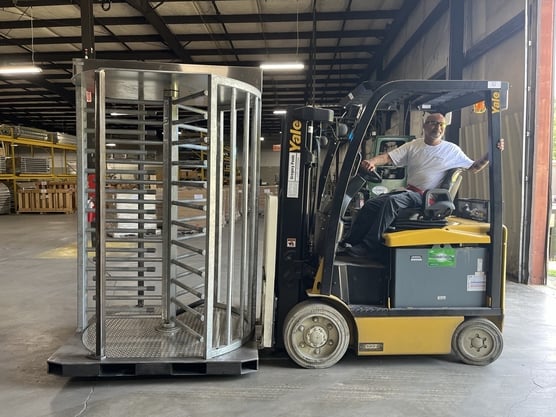
Mobile Full Height Turnstiles Provide High Security with Versatility
Construction sites need secure access control solutions that adapt to changing entry/egress points in demanding environments. Full height turnstiles can improve access control and security, preventing tailgating and unauthorized access by combining a robust physical entry barrier with electronic access control credentials. Advanced, mobile full height turnstiles placed onto a sturdy, forklift-ready steel platform accommodate evolving jobsites while eliminating the need to trench or anchor a fixed security entrance. Contractors can easily move the mobile turnstiles to new entry/egress locations as the site conditions change, enabling them to improve workforce visibility, accountability, and overall site security.
Frequently Asked Questions (FAQs)
Why are construction sites easier targets for tailgating?
Because workforces fluctuate, construction site perimeters change daily, entry/exit points are temporary, and multiple subcontractors may be on site at the same time. These factors make it challenging to ensure that only authorized people have access and create more opportunities for tailgating to occur unless organizations implement physical entrance solutions.
Isn’t temporary fencing enough to secure a construction site?
Fencing alone doesn’t verify who comes in and out of your job site or prevent someone from walking through an open gate. Think of access control as two components: perimeter protection and entry control. A physical barrier like a full height turnstile stops unauthorized individuals from entering.
How does tailgating affect construction site security?
Tailgating happens when someone who isn't allowed on site follows someone who is through a secured access point. Tailgating can compromise workforce accountability, elevate security risk, and hinder efforts to maintain accurate attendance records.
What are the limitations of paper sign-in sheets on construction sites?
Paper sign-in sheets on construction sites rely on people remembering to sign in and out when they actually arrive and depart. It also assumes that all individuals can be trusted, when unauthorized entrants may skip logging in altogether. Additionally, log sheets can have incomplete data, be circumvented and offer little real-time visibility of who is on-site. This can also complicate site audits and compliance.
Can video surveillance prevent unauthorized entry?
Video surveillance is valuable for monitoring activity and supporting investigations, but it generally records incidents after they occur. Cameras alone do not physically prevent tailgating or unauthorized access, unlike physical entrance solutions such as full height turnstiles.
How do mobile full height turnstiles support temporary construction sites?
Mobile full height turnstiles are designed for evolving jobsites where access points may change throughout a project. They help enforce one-person-per-credential entry, integrate with existing credentialing systems, and can be relocated as project needs evolve using a forklift-ready base that is easy to move, providing flexibility while improving access control.