.svg "Back to home")


Multitenant Security
Multitenant office and mixed-use buildings are now the rule, not the exception. Class A office towers with Fortune 500 companies as anchor tenants share the landscape with Class B and C properties that serve an even broader spectrum of occupiers on a daily basis. But the more diverse a tenant population is, the more challenging security can be.
Just about every company has an idea about the kind of access control it wants or needs. Some are focused on frictionless entry for visitors and streamlined traffic management. Others, such as tech firms, banks, life science organizations, or government contractors, have additional requirements to protect people, assets, and data. How can a property manager or head of security meet everyone’s needs without reducing efficiency or degrading the tenant experience?
Layered access control offers a solution. This approach applies the right security at the right point in the building, providing flexibility and scalability while creating a better security system overall.
The Problem with “One Size Fits All”
Traditional access control systems treat the lobby as the centralized access point. The lobby may have some visible presence in the form of a staffed reception area, badge readers, or even optical turnstiles. For the most part, though, a single layer of access control in the lobby is not sufficient for every tenant’s needs.
Multitenant buildings and environments are not homogeneous. Tenants come to the table with different risk profiles, different requirements, and different internal priorities. A digital marketing agency in Suite 112 is unlikely to have the same threats as a proprietary R&D lab or a company with unlisted financial information. Expecting a single access control point to meet all of those requirements is neither practical nor efficient.
Layered access control can accommodate those different risk profiles by distributing security presence across the building. This still allows for the property manager or landlord to control the lobby while giving individual tenants the ability to apply additional layers of security in areas where their own internal risk assessments indicate a need.
Layer One: The Lobby
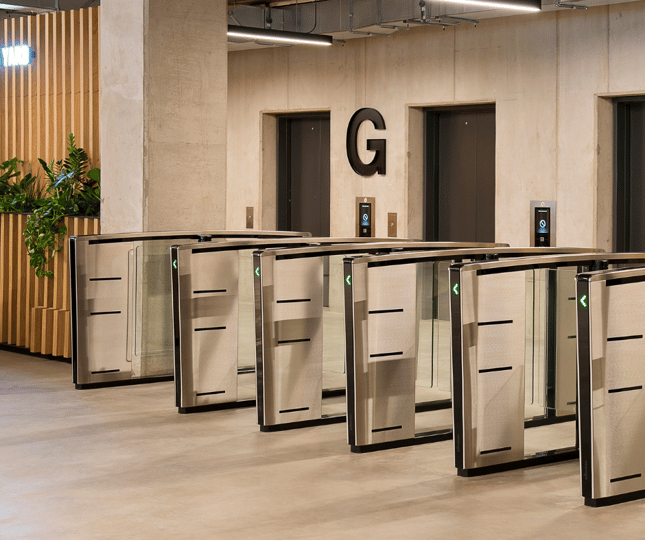
The lobby is the first layer of a multitenant access control system. It is the first point of entry and the most visible aspect of the building’s physical security to users, visitors, and prospective tenants.
Optical turnstiles or barrier systems integrated with access control software are increasingly common in modern lobbies. These solutions offer the dual advantages of openness and control. Users and visitors can access the building as needed, moving through the lobby without delays or bottlenecks. At the same time, those solutions make it extremely difficult for unauthenticated individuals to enter the building, acting as a visible deterrent against potential trespass.
For multitenant buildings and facilities, the lobby is where flexibility and scalability come into play. Lobbies often need to support multiple credential types, from proximity to mobile credentials and visitor QR codes.
Tenants within a given building often use different access systems. A multitenant lobby must accept and authenticate all of them without creating confusion or holding up traffic. A modern lobby system also collects data that can inform traffic patterns, peak traffic times, and other factors that can affect both security and tenant satisfaction.
A shared lobby may set the tone for a multitenant building, but it is not the end of the layered security story.
Layer Two: Tenant-Controlled Security in Targeted Areas
Once visitors and employees have cleared the lobby, the next area of concern is access to the tenant’s space. In some cases, tenants may be satisfied with badge access to elevators and office suites. But many multitenant occupants have a higher security bar to clear.
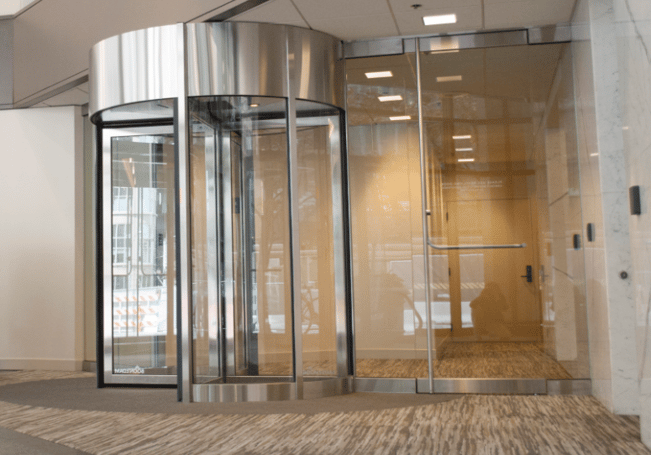
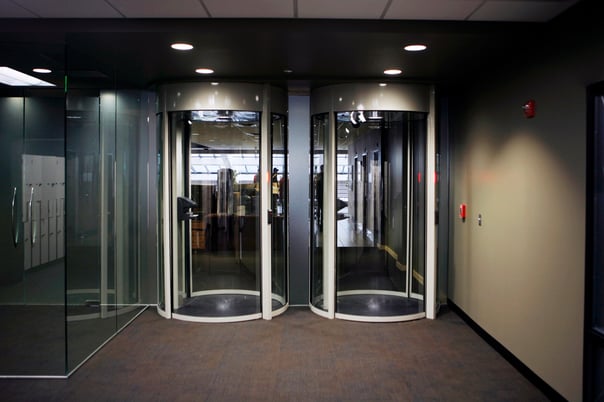
Take the example of a technology company with its headquarters on the upper floors of a mixed-use skyscraper. Badge access at the lobby door does not satisfy the company that its intellectual property, research, and development staff are safe. The firm installs a security portal at the elevator bank serving its floors.
This second layer of security offers high-security access where the tenant has determined it is needed without changing access control systems in the rest of the building. By deploying a solution that enforces single-person access and is integrated with either an access control system or biometric authentication, the tenant removes the risk of tailgating or piggybacking. This high-security solution also frees the company from needing to maintain a constant guard presence at these access points.
From a landlord’s point of view, this layered approach has several advantages. It allows tenants to bring their own understanding and management of security risks to the building without complicating shared infrastructure. This helps create a single, streamlined security approach that recognizes both the landlord’s responsibility and the tenant’s right to manage its own environment.
Layer Three: Securing and Optimizing Elevator Traffic
In high-rise multitenant buildings, elevators are an important part of the security ecosystem. The traditional elevator system, which allows riders to select any floor without regard to their own access rights, has multiple disadvantages. In busy buildings, this can increase the risk of unauthorized access as well as create congestion.
Destination dispatch can solve both problems at the same time. These systems link access credentials to elevator control, routing users to the elevator that will take them to the floors they are permitted to access. Occupants are automatically sorted into elevators without having to select a destination inside the car.
The obvious security benefit is that this greatly reduces the risk of unauthorized persons gaining access to restricted floors. The traffic management benefit is that destination dispatch routes and limits elevator stops, improving travel times and traffic flow while reducing energy usage.
Destination dispatch is a great example of layered access control’s potential for not only improving security but also making the everyday user experience better for both tenants and visitors.
Executing the Layered Approach
Implementing layered access control takes more than the right technology. It also requires planning, communication, and a clear understanding of how each layer interacts. A few key best practices can help ensure a smooth process.
Begin with a risk assessment. A full understanding of tenants, regulatory requirements, and how different areas of the building are used on a day-to-day basis is critical for a layered security system.
Design with flexibility in mind. Remember that multitenant buildings change over time. Security systems need to handle multiple credential types, integrate with multiple tenants’ access systems, and allow for scaling up or down.
Establish and communicate clear roles and responsibilities. Tenants need to know where landlord-controlled security ends and tenant-controlled security begins, and landlords need to understand where the boundaries lie.
Focus on security without sacrificing the user experience. The best layered security is invisible to building occupants. They move through the various layers naturally and without bottlenecks or confusion.
Look to the future as you plan for the present. Mobile credentials, biometric authentication, and advanced visitor management are all evolving. A layered approach to security should make it easier for tenants and landlords to adopt new technologies, not harder.
Designing Smarter Security for Modern Multitenant Buildings
Security for multitenant properties is complicated, and the challenge will only increase in the years to come. A layered access control approach enables security systems to be more flexible and adaptable without losing scalability.
From lobby solutions with advanced flexibility to tenant-controlled, high-security turnstiles, and smart elevators that secure and optimize traffic, there are solutions available for property managers, landlords, and their tenants. All of them recognize that multitenant properties serve a diverse set of occupiers and that those occupiers have different security requirements.
Security, like real estate itself, is all about location. Layered access control makes it possible to tailor that security to specific needs without reducing efficiency or the tenant experience.