.svg "Back to home")


How Security Entrances Facilitate Emergency Egress
When an emergency strikes, every second counts. As the fire alarm sounds, lights flash, and tension fills the air, the goal is clear: get everyone out safely and quickly. In those critical moments, panic and confusion can easily take over, leading to chaos, injury, or delays in evacuation. That’s why an effective, well-structured emergency egress plan is essential. And surprisingly to some, security entrances, which are often designed to control and restrict access, play an important role in that plan when configured correctly.
Planning for Calm Amid the Chaos
A structured egress plan serves as a guide during an evacuation, providing employees and visitors with clear steps to follow and routes to take. When occupants are aware of the proper procedures, they are more likely to stay calm and behave rationally, leading to an orderly exit and minimizing the risk of injury. It is also important to consider inclusive egress planning, which ensures that individuals with disabilities or limited mobility have equal access to safety. This can be achieved through features such as automatic door functions, accessible pathways, and clear signage.
Security entrances are typically designed to manage who can enter a facility, not necessarily who can leave it. However, in an emergency, every entrance is also an exit. Many types of security entrances, like tripod turnstiles, full-height turnstiles, optical turnstiles, revolving doors, and mantrap portals, can support evacuation efforts through design features that allow rapid egress when properly configured.
Compliance: The Foundation of Safe Design
Integrating security entrances into an egress plan requires careful adherence to building codes and life safety standards. The National Fire Protection Association (NFPA) and the International Building Code (IBC) set the primary guidelines for how security entrances must perform during emergencies. Supporting standards from organizations such as the American National Standards Institute (ANSI) and Nationally Recognized Testing Laboratories (NRTLs) ensure products meet safety benchmarks through testing and certification.
Partnering with a manufacturer experienced in these standards is crucial. They can help determine which security entrances may be considered part of a building’s egress route and how to configure each model for emergency operation. Compliance ensures that security entrances balance two critical needs—maintaining secure access during daily operations while supporting rapid, unobstructed evacuation when an alarm is triggered.
How Different Entrance Types Behave in an Emergency
Tripod and Full-Height Turnstiles
Turnstiles are often the first checkpoint for access control but can also assist during egress. In an emergency, many models can be set to “free-spin” mode, allowing unrestricted exit. According to NFPA and IBC standards, tripod turnstiles not exceeding 39 inches in height can be credited for partial egress (typically serving a maximum of 50 persons) but cannot act as the sole means of evacuation. In all cases, dedicated egress doors nearby must be equipped with approved panic or fire exit hardware to ensure compliance.
Optical Turnstiles
Optical turnstiles—classified by the NFPA as “security access turnstiles”—operate differently than traditional mechanical types. When integrated into an emergency response system, they can automatically retract or swing open in the direction of travel once an alarm is triggered. To ensure a building has a proper and complaint means of escape, it needs to have an automatic sprinkler system installed. Also alternative exit routes must be clearly marked and easy to access. These features help everyone evacuate smoothly and safely, with the added support of visual and audible cues to guide people during an emergency.
Security Revolving Doors
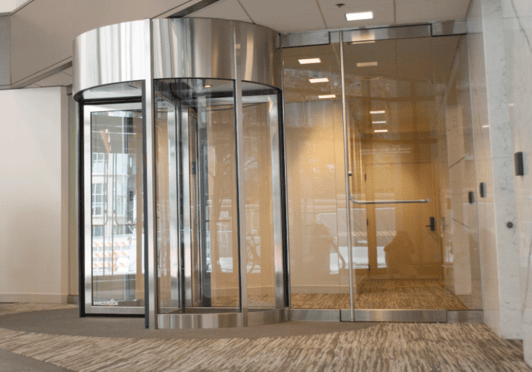
Revolving doors are highly regulated in fire and life safety codes. To be part of an egress plan, they must freely rotate when pushed and be able to “book fold” or collapse under pressure if someone pushes with a force of approximately 130 foot-pounds. This feature instantly creates an open path for quick exit. Even so, capacity limitations apply: a revolving door can accommodate no more than 50 persons or 50% of a building’s occupancy, whichever is lower. Building codes specify that there should be a swing door within 10 feet of any revolving door to ensure there's an extra exit option available.
Security Mantrap Portals
High-security portals, or mantraps, pose a unique challenge. While not explicitly covered by NFPA or IBC codes, they are often treated like security access turnstiles. To be considered part of the egress route, both portal doors must fully open during an emergency. However, many facilities opt to exclude mantraps from their evacuation plans to preserve security integrity. In those cases, the portal can be programmed to open only one door (typically the exterior one) allowing anyone trapped inside to exit safely. An adjacent, approved egress path must also be designated and kept clear.
Fail-Safe vs. Fail-Secure: Knowing the Difference
Power failure during an emergency can complicate egress. Security entrances typically operate under one of two configurations: fail-safe or fail-secure.
- Fail-safe entrances automatically unlock during a power outage, allowing free movement in or out.
- Fail-secure entrances remain locked from the outside (non-secure side) to prevent unauthorized entry but may still permit exit from the secure side
Selecting the right configuration depends on the building’s risk profile and emergency response needs. Many entrances can also be equipped with battery backup to maintain functionality during short-term outages.
Integration with Alarm and Management Systems
Modern facilities often integrate security entrances with building management systems, fire alarms, and emergency lighting. Once an alarm is triggered, the entrances automatically transition from controlled access to egress mode. Some models, such as optical turnstiles, reset automatically after an event, while others—like revolving doors—require manual inspection or repositioning by staff before resuming normal operation. Establishing a post-incident reset procedure is a best practice to restore both safety and security quickly.
Collaboration and Continuous Preparedness
Developing a solid emergency egress plan is essential for facility managers, security directors, and manufacturers to join forces. They need to make sure that all exits are up to code, accessible, and integrated into the building's overall safety plan. Regular training and evacuation drills are also vital, helping everyone understand how to use the exits safely and ensuring staff are familiar with manual override and reset procedures.
It’s also important to conduct periodic audits. As building codes change and technology improves, revisiting how egress systems are set up helps maintain compliance and ensures everything works as it should. This teamwork creates a stronger sense of accountability, making sure that every part of our facility’s entry and exit system, from credentials to control logic, functions smoothly in an emergency.
Preparedness Through Intelligent Design
Security entrances are mainly used to control who goes in and out, but when they're designed thoughtfully, they can play a vital role in emergency situations. By understanding how different entrance types function, following NFPA and IBC standards, and working with knowledgeable manufacturers, organizations can find a good balance between safety and security.
The main aim is clear: to make sure that everyone inside a building can exit quickly and safely, no matter what kind of emergency happens. With careful planning, straightforward procedures, and the right technology, security entrances can help transform panic into organized actions that can save lives.