.svg "Back to home")


Why The Data Center Entrance is Critical Infrastructure.
In most data centers, entrances are not treated as a source of risk. Access is considered “handled” once it’s installed and rarely revisited unless something fails.
Entrances don’t trigger alerts when power or cooling degrades. They don’t appear in the same monitoring dashboards as networks and servers. Yet they can be some of the most influential systems in a facility, while also being among the least frequently re-evaluated.
Not because they fail, but because they’ve worked well enough for a long time.
Entrances as Invisible Infrastructure
Power, cooling, and network infrastructure are continually reviewed and adjusted, even when they’re working as expected. Entrances don’t receive the same scrutiny because they appear to “behave.” Once installed and aligned with a process, they fade into the background and are treated like a utility that just works.
Except entrances don’t operate independently of everything else.
They require more than routine maintenance. They require intentional design and ongoing alignment with how the facility operates.
Entrances are one of the few components in a data center that sit at the intersection of security, operations, compliance, and risk. When entrance design falls short, the impact tends to be broad rather than obvious, creating exposure that doesn’t always show up in traditional monitoring or detection tools.
The consequences often surface later, through audit findings, incidents, or near misses that are difficult to trace back to the entrance itself.
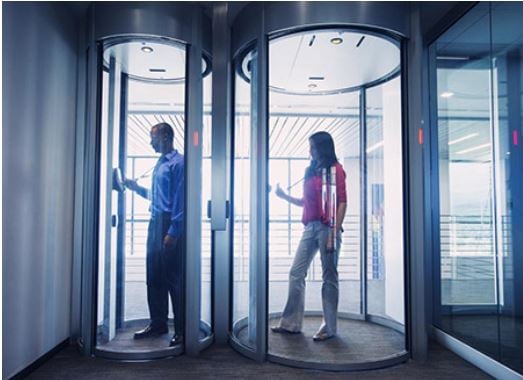
The Cyber Bypass Few Teams Intend to Build
A modern cybersecurity strategy often assumes the perimeter is already secured. Firewalls. Segmentation. Zero-trust. Identity. If a hacker can walk into your data center, it instantly negates many forms of digital protection. They’re already inside the facility.
That makes your entrance a cyber-physical control point.
Cybersecurity’s strongest assets are often expensive and time-consuming to defeat at scale from thousands of miles away. Physical access breaches are far easier to accomplish, one person at a time. Doors are held for coworkers. A familiar badge is assumed to have already been vetted by the process.
It doesn’t look malicious because it’s often not. It’s discretionary.
Accounting for the Human Element
Many organizations deploy the bulk of their access control capabilities as close to the server room as possible.
But by that point, several assumptions have already been made about who’s attempting to access your data center. How did they come to reach that point? Doors placed earlier in the journey should hold more scrutiny, not less.
Enter perimeter-first thinking.
Discretionary decisions are replaced with standardized responses whenever possible. Entrance points are designed to limit ad hoc decision-making and human reliance as people continue through your facility.
It’s how networks are designed, how buildings are segmented, and how teams reduce failure risk by limiting single points of ingress (and failure).
Entrance Risk Is Also Operational Risk
It’s tempting to view entrance failures as pure security problems, but they’re not. Outages have an operational impact.
If someone can’t access the data center to perform maintenance, turnaround times suffer. Manual processes slow response times during critical events. Inconsistent controls make audits more difficult.
The CIS Controls and Ansible’s Best Practices for Data Centers have added language specifying that you should have demonstrable physical access protections, not just defined ones. From a compliance perspective, how your facilities handle stress is just as important as how they operate under ideal conditions.
But even organizations with enough people to dedicate to front door monitoring will eventually run into scaling issues. Data centers are meant to operate 24/7, but people are not. If your entry processes rely on continuous human vigilance, that won’t happen when someone gets the flu or takes a vacation; your ability to resist attacks will fracture.

Entrances at the Intersection of IT, Security, and Facilities
IoT botnets don’t start with physical security breaches. But your entrance is your highest potential risk point for both because it sets the tone for how security (cyber and physical) is treated.
Here are a few examples of where entrances unexpectedly undermine security and compliance efforts:
- Shared entrances where contractors, staff, and vendors are coming and going through the same doors.
- Willful tailgating during busy hours. It’s against policy, but facilitates throughput.
- Emergency or offline modes during outages, when keeping doors open trumps access control.
- Legacy entrances that work “OK” but don’t necessarily meet your current cybersecurity risk posture.
Collectively, these issues create openings that aren’t easily visible from the inside.
What “Critical Infrastructure” Really Means Here
Uptime risk
What happens when an entrance goes down? Will your employees still be able to access your building safely? Will you need to completely disarm your security system just to allow emergency access?
Operational continuity
How smoothly can your entrance handle the complex ebb and flow of employees, contractors, vendors, auditors, and emergency responders? If that flow falters or slows, do staff absorb the headache, or loosen controls just to keep things moving?
Compliance and audit readiness
Audit groups don’t just review logs. They assess whether processes are defined, repeatable, and enforced. When entrances lack standard access paths or are used inconsistently across roles and scenarios, those gaps become visible quickly during an audit.
Labor efficiency
Access systems often fail to consistently enforce policy. People try to compensate. Guards step up. Internal staff double-check what technology should already be handling.
Over time, that compensation becomes part of the operating model. Labor is redirected from higher-value work to monitoring, verification, and exception handling that a well-designed entrance system should absorb.
How Mature Data Centers Think About Entrances Differently
When entrances are treated as infrastructure rather than hardware, the benefits show up across the business. Labor costs go down as standardization makes processes simpler. Peak time congestion is reduced, more and better data provide visibility into movement and utilization, and shrinkage losses go down. The operations are easier to scale as facilities and teams expand.
Most importantly, the entrance system becomes flexible rather than fragile. It can expand and evolve to meet new demands in automation, analytics, and more.
One Last Perspective
Entrances matter because they sit at the intersection of cyber and physical security. They function as control points for both. Yet reliability expectations for entrances often lag behind those applied to other critical infrastructure.
The more useful question is whether the existing entrance design still reflects the facility’s current risk profile. What worked years ago may no longer align with today’s operational, compliance, or threat landscape.
When entrances aren’t evaluated with the same discipline as power, cooling, or networks, weaknesses tend to surface elsewhere in the system.
The front door isn’t just another layer of risk. It’s the foundation of the entire entrance strategy.