Construction sites rarely look the same from one week to the next. Temporary entry/egress points can become permanent ones, while others move or disappear completely. Effective site security requires long-term planning to accommodate changes. This is especially true for physical access control, which needs to adapt throughout the project lifecycle to prevent gaps in security, accountability, and operations.
Why Does Construction Site Access Control Need to Change as the Project Evolves?
Construction environments are dynamic by nature. Access points that make sense during site preparation or early structural work can quickly change. If security entrances are static and difficult to relocate, site personnel may begin relying on temporary openings, secondary gates, or manually monitored entry points which can compromise security.
An effective approach is to treat access control as an evolving part of site operations. Entrance locations, traffic patterns, and workforce access should all be part of the long-term site project planning so they can evolve in step with the project. 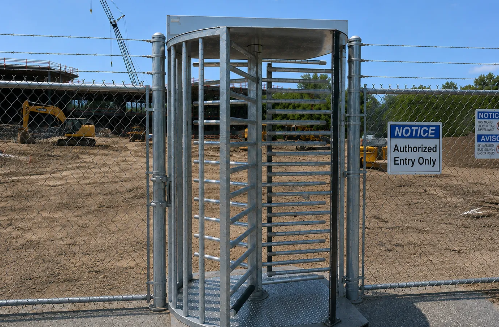
Where Do Security Gaps Typically Appear as Jobsites Evolve?
Access control gaps often develop during transitions. A perimeter may be moved to accommodate a new construction phase. An entryway may need to be relocated. A new building section may open, changing how workers move through the property. Responsibility for certain areas may also shift as different phases of the project are completed. These changes can create new security challenges, including:
-
Temporary entrances with inconsistent security and access controls
-
Gaps in fencing that create new pedestrian access points
-
The creation of unsupervised access points
-
Work zones that require higher levels of security as construction progresses
-
Access infrastructure that remains in place even after traffic patterns have changed
Identifying potential access changes during site and project planning can help eliminate these gaps.
How Can Contractors Maintain Consistent Security on a Changing Jobsite?
The ability to maintain the same level of access control and management across all entry/egress site locations provides numerous security and economic advantages. An adaptable access control strategy allows construction teams to relocate controlled entry points as site conditions change without having to rebuild permanent security infrastructure with each move. Planning for security entrance mobility should be addressed early in the planning process by asking the following:
-
Will entry/egress points need to be moved during various phases of construction?
-
How difficult will it be to relocate security entrances if traffic patterns change?
-
Will moving the security entrances require new concrete, trenching, wiring, or other infrastructure?
-
Will the access control system continue to work with existing credentials and security technologies after it moves?
-
Can additional controlled entrances easily be added and integrated/networked if the workforce or project footprint grows?
Planning around these questions can make it easier to maintain security without interfering with construction schedules.
What Should Adaptable Jobsite Access Control Provide?
Mobility is one part of the selection criteria for construction site security entrances. A temporary or relocated entrance still needs to effectively serve as a critical security layer. Effective jobsite security should provide a combination of robust physical security, operational flexibility, and system integration. Evaluation criteria include:
Physical access enforcement: The entrance should create a defined point of entry and help ensure that authorization decisions are physically enforced.
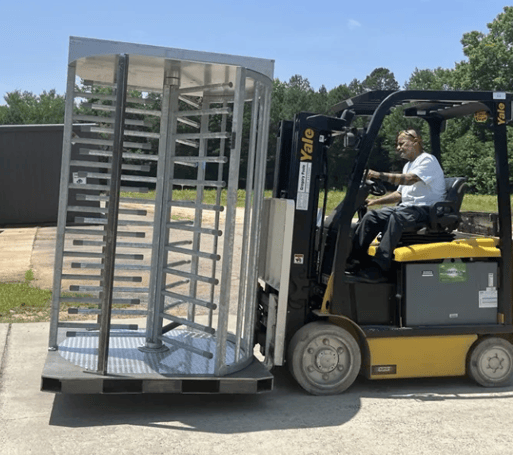
Rapid deployment and relocation: Security infrastructure should be able to easily move as construction phases, perimeters, and access requirements change.
Integration: Relocating an entrance should not require construction teams to abandon existing credentialing or access control systems.
Durability: Equipment used on active jobsites must be able to perform in demanding outdoor environments.
Scalability: The access strategy should be able to expand as workforce levels increase or additional entrances are required.
Combining these capabilities allows physical security to evolve in step with projects rather than become obstacles to them.
How Does Mobile Access Control Support an Evolving Construction Site?
Mobile full-height turnstiles provide a defined pedestrian entrance that can be relocated as fencing, work zones, or pedestrian traffic patterns change throughout the project. Because the security entrance moves with the site, contractors can maintain a consistent approach to physical access control even though the physical layout continues to evolve. This is particularly valuable on large, multi-phase projects where entrance locations may change several times before construction is complete.
Planning Security for the Full Project Lifecycle
By carefully planning the need and location of security entrances across a project’s lifecycle, construction sites can maintain higher security with greater consistency and cost efficiency. One proven solution is Boon Edam’s Turnlock 100 Mobile Platform, which combines a full-height physical security entrance and a forklift-ready base that allows the unit to be deployed, relocated, and redeployed as site conditions change. The platform does not require permanent anchoring, slab installation, or trenching for standard deployment, and can integrate with modern access control and sensor solutions to deliver the highest levels of protection.
It is designed to help construction teams maintain consistent access control as the jobsite continues to evolve.
Learn more about Boon Edam mobile access control solutions for construction sites.